As you well know, the Circular Economy It is increasingly taking root in our society. This scenario involves public actors responsible for sustainable development, companies seeking economic, social, and environmental results, as well as society in general, who are increasingly questioning their real needs.
The term Circular Economy We can define it as a new economic and social system that aims to "produce goods and services while reducing consumption and waste of raw materials, water and energy sources"«
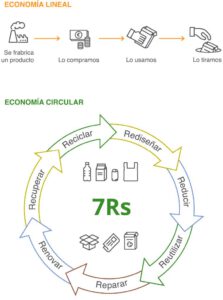
Therefore, the Spanish Circular Economy Strategy, Spain Circular 2030 It lays the foundations for promoting this new model of production and consumption in which the value of products, materials and resources is maintained in the economy for as long as possible, in which the generation of waste is minimized and those that cannot be avoided are used to the greatest extent possible.
2030 GOALS
- Reduce in a 30% consumption national materials in relation to GDP, taking 2010 as the reference year.
- Reduce the waste generation a 15% with respect to what was generated in 2010.
- Reduce the food waste generation throughout the food chain: 50% of per capita reduction at the household and retail consumption level and a 20% in production and supply chains from 2020 onwards, thus contributing to the SDGs.
- Increase reuse and preparation for reuse until reaching 10% of the municipal waste generated.
- Improve a 10% water use efficiency.
- Reduce the greenhouse gas emissions below 10 million tons of CO22 equivalent.
NATIONAL CONTEXT. LAW 7/2021, ON CLIMATE CHANGE AND ENERGY TRANSITION
The new Climate Change and Energy Transition Law It plans to require companies to calculate and make public their Carbon Footprint, as well as working on plans to reduce its greenhouse gas emissions.
To this end, the Government's Delegate Commission for Economic Affairs will determine within one year which companies operating in Spain will be required to calculate and publish their Carbon Footprint, with which indicators and their frequency.
Furthermore, the Law incorporates requirements regarding the Carbon Footprint relating to the public procurement. Within one year of its entry into force, the Ministry for Ecological Transition and the Demographic Challenge (MITERD) will draw up a catalogue of services whose procurement will take into account climate change mitigation criteria. In this regard, the inclusion of [the following] is planned. tender documents of award criteria linked to the fight against climate change and of specific technical requirements that establish the necessary reduction of emissions and carbon footprint.
It also establishes a framework to facilitate the sustainable investments. The reporting obligations of the financial sector and companies are outlined. The following are introduced: obligation to present a annual report This report must assess the financial impact of climate change-related risks arising from their business activities. From 2023 onwards, credit institutions must publish specific decarbonization targets for their loan and investment portfolios.
? 670 036 546 / ? info@incyma.es
#INCYMA #ConsultoríaSistemasDeGestión #Sosstenibilidad #HuellaDeCarbono #CambioClimático #Emisiones #ResponsabilidadSocial #PEIEC #ContrataciónPública
Sources: EQA, miteco.gob.es, legal news.
Share the content on social media!